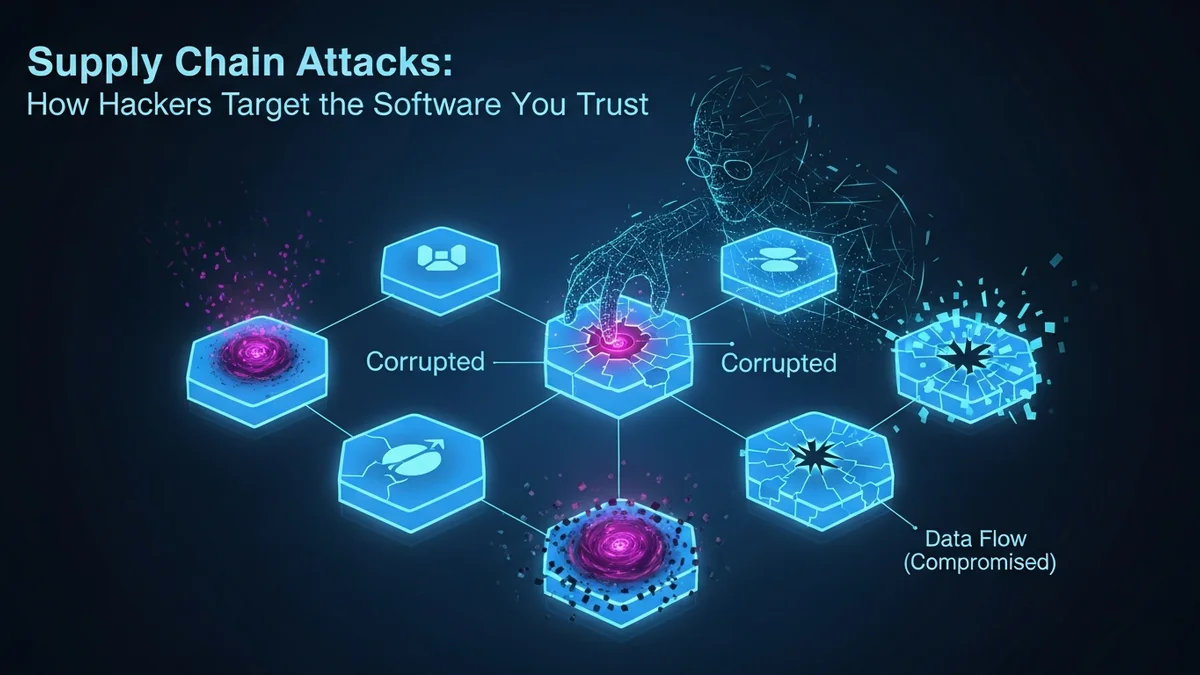
Supply chain attacks have become one of the most dangerous cybersecurity threats facing businesses and individuals today. Instead of attacking you directly, hackers compromise the software, service, or vendor you already trust — then use that trusted relationship to infiltrate your systems.
This strategy is highly effective. By breaching a single supplier, attackers can potentially access thousands of organizations in one move. In recent years, supply chain attacks have impacted governments, Fortune 500 companies, hospitals, and everyday consumers.
Understanding how these attacks work — and how to reduce your risk — is essential in a world where nearly every company depends on third-party software.
What Is a Supply Chain Attack?
A supply chain attack occurs when cybercriminals compromise a trusted third-party vendor in order to gain access to that vendor’s customers. Instead of attacking each target individually, hackers exploit the “supply chain” — the ecosystem of software providers, IT services, contractors, and infrastructure partners that organizations rely on.
Common supply chain targets include:
- Software updates and code repositories
- Managed service providers (MSPs)
- Cloud service platforms
- Open-source software components
- Hardware manufacturers
Because updates and integrations are typically trusted and automatically installed, malicious code inserted upstream can spread quickly and quietly.
Real-World Examples of Devastating Supply Chain Attacks
Supply chain attacks are not theoretical — they’ve caused some of the most significant breaches in recent history.
SolarWinds (2020): Attackers inserted malicious code into a routine software update for SolarWinds’ Orion IT monitoring platform. Approximately 18,000 customers downloaded the compromised update, including U.S. federal agencies and major corporations. The breach is widely considered one of the most sophisticated cyber-espionage campaigns ever discovered.
Kaseya (2021): A ransomware group exploited vulnerabilities in Kaseya’s remote management software, impacting up to 1,500 businesses worldwide through managed service providers. One compromised vendor created a ripple effect across hundreds of downstream clients.
NotPetya (2017): Initially spread through a compromised Ukrainian accounting software update, NotPetya caused an estimated $10 billion in global damages. Companies like Maersk and FedEx experienced massive operational disruptions.
These incidents highlight a critical lesson: even if your own security is strong, your vendors’ vulnerabilities can become your problem.
Why Supply Chain Attacks Are So Effective
Hackers favor supply chain attacks for several reasons:
- Built-in trust: Organizations inherently trust their vendors’ updates and integrations.
- Mass scale: One breach can impact thousands of customers.
- Stealth: Malicious code hidden in legitimate software often evades detection for months.
- Privilege escalation: Third-party tools often require high-level system access.
Additionally, modern businesses rely heavily on interconnected SaaS platforms. The average organization uses well over 100 SaaS applications, dramatically expanding the potential attack surface.
Once attackers gain access through a trusted vendor, they can steal credentials, exfiltrate sensitive data, deploy ransomware, or move laterally across networks.
Warning Signs of a Compromised Vendor
Supply chain attacks are notoriously difficult to detect, but certain red flags may indicate a problem:
- Unexpected software behavior after an update
- Unusual outbound network traffic
- New administrator accounts appearing without explanation
- Vendors delaying or withholding security disclosures
- Credential exposure alerts tied to third-party platforms
This is where proactive monitoring becomes critical. If your email addresses or employee credentials appear in a breach involving a vendor, early detection can significantly reduce damage. Tools like LeakDefend continuously monitor breached databases and alert you when your email addresses appear in newly exposed datasets.
How to Protect Your Business from Supply Chain Attacks
While you cannot eliminate third-party risk entirely, you can significantly reduce exposure with layered defenses:
- Vet vendors carefully: Assess their security practices, compliance certifications, and breach history.
- Limit access privileges: Apply the principle of least privilege to all third-party integrations.
- Monitor software updates: Validate digital signatures and track unusual changes.
- Segment your network: Prevent attackers from moving freely if one system is compromised.
- Implement continuous breach monitoring: Detect exposed credentials before attackers exploit them.
Credential exposure is often the first step in broader compromise. If a vendor suffers a breach and employee login credentials are leaked, attackers may attempt credential stuffing or phishing campaigns against your organization.
LeakDefend.com lets you check all your email addresses for free and monitor up to three addresses continuously. Early alerts allow you to reset passwords, enable multi-factor authentication, and secure accounts before damage spreads.
The Growing Risk of Open-Source Dependencies
Modern software development heavily depends on open-source libraries. While open-source innovation accelerates progress, it also introduces supply chain risk.
In 2023, security researchers reported a surge in “dependency confusion” and malicious package uploads to repositories like npm and PyPI. Attackers upload packages with names similar to legitimate ones, hoping developers will accidentally install them.
Even a single compromised open-source component can propagate through thousands of applications. Because these dependencies are often deeply embedded, vulnerabilities can persist undetected for years.
This interconnected reality means organizations must think beyond perimeter defenses. Monitoring exposure, tracking vendor risk, and maintaining credential hygiene are essential parts of modern cybersecurity.
Supply Chain Security Is Everyone’s Responsibility
Supply chain attacks demonstrate a fundamental shift in cybercrime strategy. Instead of breaking down the front door, attackers hijack the delivery truck.
No organization operates in isolation. Your security posture depends not only on your internal defenses but also on the security maturity of every partner, vendor, and software provider you rely on.
By combining vendor due diligence, access controls, continuous monitoring, and rapid response planning, you can dramatically reduce your exposure.
🔒 Check If Your Email Was Breached — Monitor up to 3 email addresses for free with LeakDefend. Start Your Free Trial →
Conclusion
Supply chain attacks are powerful because they exploit trust — the trust you place in software updates, service providers, and digital ecosystems. High-profile incidents like SolarWinds and Kaseya prove that even reputable vendors can become entry points for large-scale breaches.
The solution isn’t abandoning third-party software — it’s building resilience. Limit access, verify vendors, monitor for anomalies, and track credential exposure continuously. Services like LeakDefend provide early warning when your email addresses appear in data breaches, helping you act before attackers do.
In today’s interconnected world, cybersecurity is shared responsibility. The more visibility you have into your digital footprint, the harder it becomes for attackers to turn your trusted tools against you.