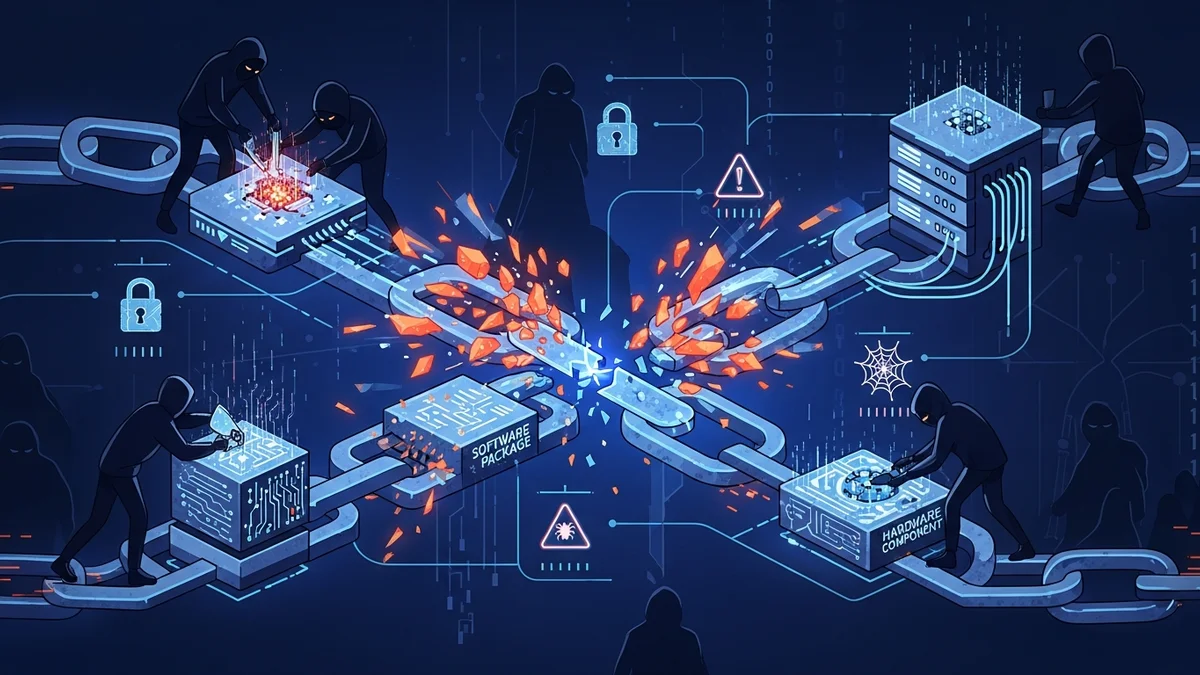
When you install a software update, you expect it to improve security—not compromise it. But in a supply chain attack, hackers infiltrate trusted software vendors and use legitimate updates as Trojan horses. Instead of targeting victims one by one, attackers compromise a single supplier and gain access to thousands—or even millions—of downstream users.
Supply chain attacks have become one of the most dangerous cybersecurity threats in recent years. From global enterprises to individual users, no one is immune when the tools we rely on every day become attack vectors.
What Is a Supply Chain Attack?
A supply chain attack occurs when cybercriminals compromise a trusted third-party vendor, service provider, or software component to distribute malware or gain unauthorized access to systems. Rather than attacking a company directly, hackers infiltrate its “supply chain” — the network of partners, vendors, and tools it depends on.
Common supply chain attack vectors include:
- Compromised software updates that install malware
- Infected open-source libraries used in applications
- Third-party service providers with weak security controls
- Hardware tampering during manufacturing or distribution
Because these attacks exploit trust relationships, they are extremely difficult to detect. Security systems often treat vendor software as safe by default.
Real-World Examples of Devastating Supply Chain Attacks
Several high-profile breaches have demonstrated the scale and impact of supply chain attacks.
SolarWinds (2020) is perhaps the most infamous example. Attackers inserted malicious code into updates for SolarWinds’ Orion IT monitoring software. Approximately 18,000 customers installed the compromised update, including U.S. government agencies and Fortune 500 companies. The attack went undetected for months and is widely considered one of the largest espionage campaigns in history.
Kaseya (2021) involved ransomware distributed through a managed service provider (MSP) software platform. By exploiting Kaseya’s VSA tool, attackers were able to push ransomware to up to 1,500 downstream businesses in a single coordinated event.
NotPetya (2017) began as a supply chain attack targeting a Ukrainian accounting software provider. The malware spread rapidly, causing an estimated $10 billion in global damages, according to the White House.
These incidents show how a single compromised vendor can create a cascading global security crisis.
Why Supply Chain Attacks Are So Effective
Supply chain attacks work because they exploit trust and scale.
- Trusted sources bypass defenses: Security systems often whitelist approved vendors and signed software updates.
- Mass distribution: One breach can affect thousands of organizations simultaneously.
- Delayed detection: Malicious code hidden in legitimate updates can remain dormant for weeks or months.
- Complex ecosystems: Modern software relies heavily on open-source components and third-party APIs, increasing exposure.
According to industry research, over 90% of modern applications contain open-source components. Each dependency introduces potential risk if not properly monitored.
For individuals, the danger is indirect but real. If a company you use experiences a supply chain breach, your personal data—email address, passwords, billing details—may be exposed. That’s why tools like LeakDefend are critical: they monitor your email addresses across known data breaches so you can react quickly if your information surfaces online.
How Hackers Execute a Supply Chain Attack
While tactics vary, most supply chain attacks follow a similar pattern:
- Step 1: Reconnaissance — Attackers identify widely used software vendors or service providers.
- Step 2: Initial compromise — They exploit vulnerabilities, phishing campaigns, or stolen credentials to access the vendor’s systems.
- Step 3: Code injection — Malicious code is inserted into software builds or update mechanisms.
- Step 4: Distribution — Customers unknowingly download and install the compromised update.
- Step 5: Exploitation — Attackers establish backdoors, exfiltrate data, or deploy ransomware.
Because the attack rides along with legitimate software, even cautious users may not detect anything unusual.
How Organizations Can Reduce Supply Chain Risk
Businesses must treat third-party risk as seriously as internal security. Key defensive strategies include:
- Vendor risk assessments before onboarding suppliers
- Zero trust architecture that verifies every access request
- Code signing validation and integrity monitoring
- Software bill of materials (SBOM) to track dependencies
- Continuous patching and monitoring
The U.S. Cybersecurity and Infrastructure Security Agency (CISA) now recommends SBOM adoption to improve transparency in software supply chains. Visibility is critical—organizations can’t secure what they don’t know exists.
What Individuals Can Do to Stay Protected
While individuals have less control over vendor security, there are practical steps to minimize damage from supply chain attacks:
- Use unique passwords for every account
- Enable multi-factor authentication (MFA) wherever possible
- Keep devices updated with official patches
- Monitor your accounts for suspicious activity
- Track data breaches associated with your email addresses
If a trusted service you use suffers a breach, attackers may attempt credential stuffing attacks on other platforms. Monitoring exposure is essential. LeakDefend.com lets you check all your email addresses for free and receive alerts if they appear in known data leaks, helping you respond before criminals can exploit stolen data.
🔒 Check If Your Email Was Breached — Monitor up to 3 email addresses for free with LeakDefend. Start Your Free Trial →
The Future of Supply Chain Security
As software ecosystems grow more interconnected, supply chain attacks are likely to increase. Cybercriminal groups and nation-state actors recognize the efficiency of targeting a single supplier to infiltrate thousands of victims.
Governments worldwide are responding with stricter regulations and cybersecurity standards. However, security ultimately depends on layered defenses, transparency, and proactive monitoring.
The lesson is clear: trust must be verified continuously. Whether you’re a multinational enterprise or an individual user, understanding supply chain threats—and preparing for them—can significantly reduce your risk.
Conclusion
Supply chain attacks represent a fundamental shift in cybercrime strategy. Instead of breaking down your front door, attackers compromise someone you already trust—and walk in through the side entrance.
High-profile breaches like SolarWinds, Kaseya, and NotPetya prove that even reputable vendors can become unwitting attack vectors. Organizations must strengthen vendor oversight and software transparency, while individuals should adopt strong password hygiene and breach monitoring practices.
In a world where even trusted software can turn malicious, vigilance is no longer optional. Staying informed, implementing layered security, and using monitoring tools like LeakDefend can help ensure that when the next supply chain attack strikes, you’re prepared—not surprised.