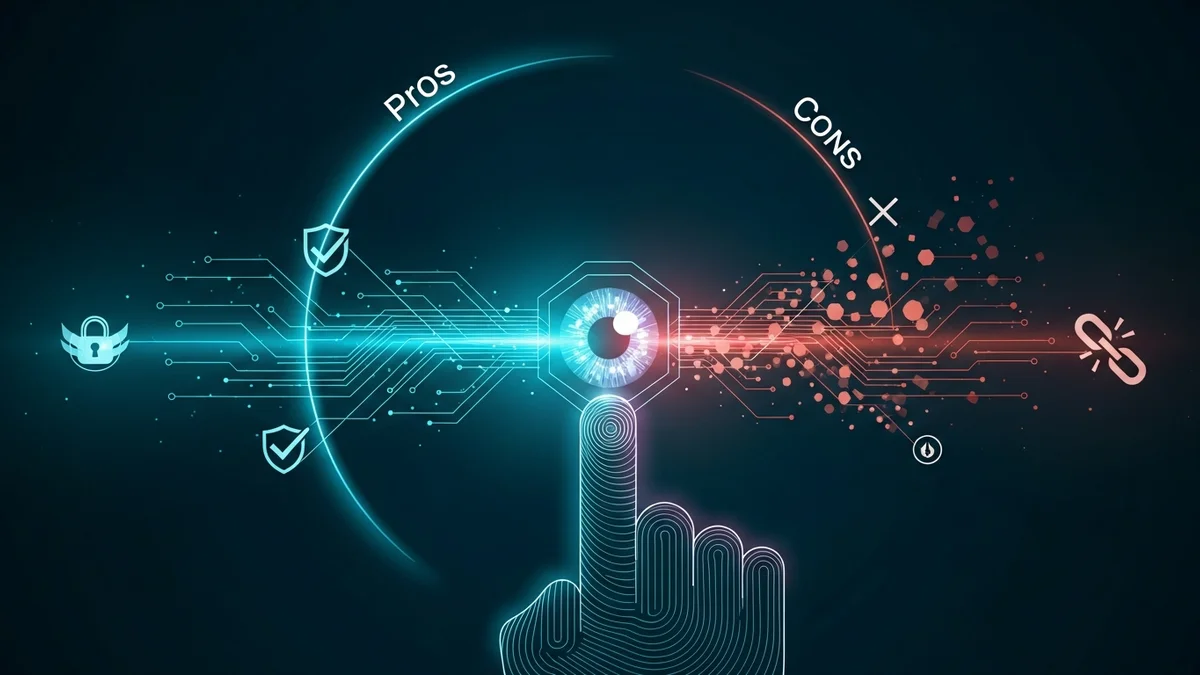
Biometric authentication has quickly moved from science fiction to everyday reality. Millions of people now unlock their phones with a fingerprint, scan their faces to access banking apps, or use voice recognition to interact with smart devices. According to industry reports, more than 80% of smartphones worldwide now support some form of biometric login.
But while biometrics promise stronger security and seamless convenience, they also introduce new risks. Unlike passwords, you can’t change your fingerprint if it’s compromised. Understanding the pros and cons of biometric authentication is essential for anyone serious about protecting their digital identity.
What Is Biometric Authentication?
Biometric authentication verifies identity using unique biological or behavioral traits. Instead of something you know (like a password) or something you have (like a security token), biometrics rely on something you are.
Common types include:
- Fingerprint recognition
- Facial recognition
- Iris or retina scans
- Voice recognition
- Behavioral biometrics (typing rhythm, mouse movement patterns)
These systems compare scanned data against stored templates. If the match meets a certain threshold, access is granted.
On the surface, this sounds more secure than passwords. But security is never absolute — only layered.
The Pros of Biometric Authentication
Let’s start with the advantages. Biometrics have gained widespread adoption for good reason.
1. Convenience and Speed
There’s no password to remember, reset, or mistype. Unlocking a phone with Face ID takes less than a second. This frictionless experience increases user adoption of security measures that might otherwise be ignored.
2. Harder to Guess or Brute-Force
Weak passwords remain one of the biggest cybersecurity problems. According to Verizon’s Data Breach Investigations Report, compromised credentials are involved in a significant percentage of breaches. Biometrics eliminate the risk of “123456” or reused passwords being exploited.
3. Reduced Phishing Risk
Phishing attacks trick users into revealing passwords. Since biometrics are not typed into fake websites, they reduce exposure to traditional phishing methods. However, attackers may still target backup authentication methods.
4. Stronger Multi-Factor Authentication (MFA)
Biometrics are most powerful when combined with another factor, such as a device or passcode. Multi-factor authentication significantly reduces account takeover risk. Many banks now require biometric confirmation within their apps for sensitive transactions.
5. Difficult to Share or Transfer
Passwords can be shared. Fingerprints cannot. This limits unauthorized account sharing and internal misuse.
The Cons and Security Risks of Biometrics
Despite these strengths, biometric authentication comes with serious trade-offs.
1. You Can’t Change Your Biometrics
If a password is exposed in a data breach, you can change it instantly. If your fingerprint template is compromised, you’re stuck with it for life.
This risk became more visible after the 2015 U.S. Office of Personnel Management (OPM) breach, where attackers stole the fingerprint records of approximately 5.6 million federal employees. While fingerprint templates are stored differently from raw images, the incident highlighted a critical concern: biometric data is permanent.
2. Biometric Data Can Be Stolen
Biometric systems don’t store your actual fingerprint or face image. They store mathematical representations. However, if attackers gain access to those templates, they may attempt replay attacks or exploit weaknesses in poorly implemented systems.
Centralized biometric databases are particularly attractive targets for cybercriminals.
3. False Positives and False Negatives
No biometric system is 100% accurate. There are always:
- False positives (unauthorized users granted access)
- False negatives (legitimate users denied access)
Facial recognition systems have faced criticism for demographic bias, with some studies showing higher error rates for women and people of color.
4. Privacy Concerns
Biometric data is deeply personal. Unlike passwords, it can reveal sensitive characteristics about you. Governments and corporations collecting biometric information raise questions about surveillance, consent, and long-term data storage.
In some regions, data protection laws like GDPR classify biometric data as "special category" information, requiring stricter handling.
5. Physical Coercion Risks
In rare scenarios, biometrics can be used under duress. A fingerprint can be physically forced onto a sensor, whereas a memorized password cannot be extracted the same way.
Biometrics vs. Passwords: Which Is Safer?
The real answer isn’t “either/or.” It’s layered security.
Passwords alone are weak — especially reused ones. Data breaches expose billions of credentials every year. Tools like LeakDefend help users monitor their email addresses for breach exposure so they can act quickly if credentials are compromised.
Biometrics alone also have limitations. The safest approach combines:
- Biometric login
- A strong, unique password
- Multi-factor authentication
- Continuous breach monitoring
For example, if your password appears in a data leak, platforms like LeakDefend.com let you check all your email addresses for free and receive alerts when new breaches occur. Even if you use biometrics daily, your accounts often still rely on passwords behind the scenes.
Best Practices for Using Biometric Authentication Safely
If you choose to use biometrics — and most people already do — follow these security guidelines:
- Enable device encryption so stored biometric templates remain protected.
- Use biometrics only on trusted devices, not shared public systems.
- Keep strong backup passwords in case biometric access fails.
- Turn on account breach monitoring to catch exposed credentials early.
- Enable multi-factor authentication wherever available.
Remember: biometric authentication protects access to a device or app — but it does not prevent your email address from appearing in a third-party data breach. That’s why identity monitoring remains critical.
Conclusion: Convenience With Caution
Biometric authentication offers clear advantages: speed, convenience, and stronger resistance to brute-force attacks. It represents a major step forward from weak, reused passwords.
However, biometrics are not invincible. They introduce privacy risks, permanence issues, and new breach implications that users must understand. The 2015 OPM breach demonstrated that even biometric data can be exposed at scale.
The smartest strategy isn’t to avoid biometrics — it’s to use them wisely. Combine them with strong passwords, multi-factor authentication, and proactive monitoring tools like LeakDefend to detect when your credentials appear in a breach.
Security is never about a single solution. It’s about layers. And in today’s threat landscape, every layer matters.