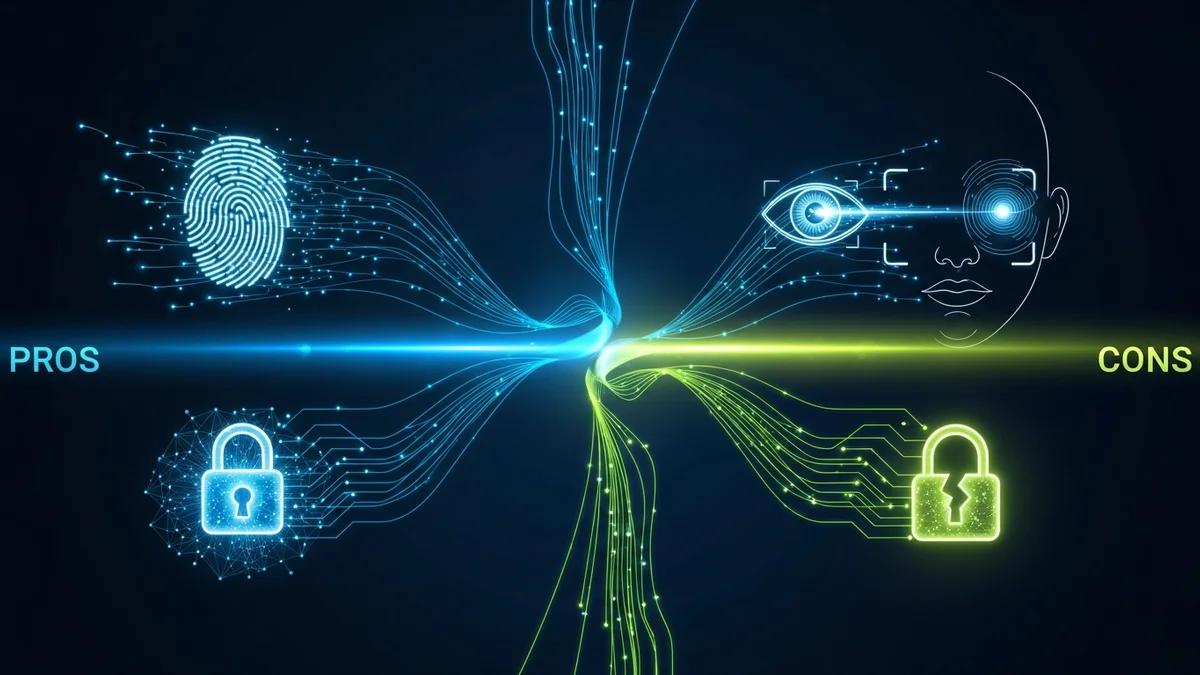
Biometric authentication has rapidly moved from science fiction to everyday reality. Millions of people now unlock their phones with fingerprints, scan their faces to access banking apps, or use voice recognition to log into accounts. According to industry estimates, over 80% of smartphones globally now support biometric authentication in some form.
On the surface, biometrics seem like the perfect solution to password fatigue and account takeovers. After all, you can’t forget your fingerprint. But while biometric authentication offers clear advantages, it also introduces serious privacy and security concerns that many users don’t fully understand.
Here’s a balanced look at the real pros and cons of biometric authentication — and what you should consider before relying on it as your primary security layer.
What Is Biometric Authentication?
Biometric authentication uses unique biological characteristics to verify identity. These can include:
- Fingerprints
- Facial recognition
- Iris or retina scans
- Voice recognition
- Behavioral biometrics (typing patterns, mouse movements)
Unlike passwords or PIN codes, biometric data is tied directly to who you are. Most modern systems store this data locally on a secure device chip (such as Apple’s Secure Enclave or Android’s Trusted Execution Environment), rather than in a central database.
However, not all implementations are equal — and that distinction matters when evaluating the risks.
The Pros of Biometric Authentication
1. Convenience and Speed
Biometrics dramatically reduce friction. Unlocking a phone with a fingerprint takes milliseconds. There’s no need to remember complex passwords or reset forgotten credentials.
This convenience leads to better user behavior. When security is easy, people are more likely to enable it.
2. Harder to Guess or Brute Force
Unlike passwords, biometric traits cannot be guessed or cracked through traditional brute-force attacks. A hacker cannot simply "try combinations" of your fingerprint remotely.
This makes biometrics highly resistant to credential stuffing attacks, which remain one of the most common causes of account takeovers.
3. Reduced Phishing Risk
Biometrics are generally tied to a specific device. That means even if you fall for a phishing attack, an attacker cannot easily replicate your fingerprint or face remotely.
With phishing attacks increasing globally — the FBI’s Internet Crime Complaint Center consistently reports billions in annual losses — reducing reliance on passwords is a meaningful advantage.
4. No Password Reuse Problem
Password reuse is responsible for a significant percentage of breaches. When one site is compromised, attackers test the same credentials elsewhere. Tools like LeakDefend help users monitor exposed email addresses and detect when credentials appear in known breaches, but eliminating password reuse entirely is even better. Biometrics sidestep this issue because there’s nothing to reuse.
The Cons of Biometric Authentication
1. You Can’t Change Your Biometrics
If your password is leaked, you can change it instantly. If your fingerprint template or facial scan data is compromised, you cannot replace your fingerprint or face.
This is one of the most serious long-term risks of biometric authentication.
In 2019, security researchers discovered a breach of the BioStar 2 biometric security platform, exposing over 1 million fingerprints and facial recognition records. The data was stored in an unsecured database. Unlike passwords, those exposed biometrics were permanently compromised.
2. Centralized Database Risks
While smartphones typically store biometric data locally, enterprise systems, border control systems, and workplace time-tracking platforms may store biometric data in centralized servers.
Centralized biometric databases become high-value targets. A breach involving biometric identifiers can have lifelong consequences for affected individuals.
3. False Positives and False Negatives
No biometric system is perfect. Accuracy depends on implementation quality, environmental conditions, and algorithm strength.
Facial recognition systems have been shown in multiple studies — including research from MIT — to have higher error rates for women and people of color. False positives (letting the wrong person in) and false negatives (blocking legitimate users) both pose security and usability concerns.
4. Legal and Privacy Concerns
Biometric data is highly sensitive personal information. In some jurisdictions, law enforcement can compel biometric unlocking (like fingerprint access) more easily than forcing someone to reveal a memorized password.
There are also broader concerns about surveillance. Widespread facial recognition use in public spaces has triggered regulatory action in parts of the U.S. and Europe due to privacy implications.
5. Spoofing and Presentation Attacks
Although difficult, biometric systems are not immune to spoofing. Researchers have demonstrated methods to bypass fingerprint scanners using high-resolution prints and to trick facial recognition systems with 3D masks or detailed images.
Advanced systems use "liveness detection" to counter these attacks, but lower-cost implementations may not.
Biometrics vs. Passwords: Which Is Safer?
The truth is that biometric authentication is not a replacement for strong security practices — it’s a layer.
Security experts increasingly recommend multi-factor authentication (MFA), combining:
- Something you know (password)
- Something you have (device or security key)
- Something you are (biometric)
Biometrics work best as a convenience layer on top of strong cryptographic protection. For example, unlocking a password manager with Face ID is far safer than relying on Face ID alone for every account.
And remember: many account breaches don’t happen because someone guessed your fingerprint. They happen because your email and password were exposed in a third-party data breach.
That’s why monitoring your digital exposure matters. LeakDefend.com lets you check all your email addresses for free and alerts you when they appear in known breach databases — helping you respond quickly before attackers can exploit leaked credentials.
Best Practices for Using Biometric Authentication Safely
- Enable biometrics only on trusted personal devices.
- Pair biometrics with strong, unique passwords.
- Use a password manager to avoid reuse.
- Enable multi-factor authentication wherever available.
- Monitor your email addresses for breach exposure.
Even if you rely on biometrics daily, you should still assume that data breaches are inevitable. Proactive monitoring through tools like LeakDefend adds an essential early-warning layer to your overall security strategy.
Conclusion: Powerful, But Not Perfect
The pros and cons of biometric authentication reveal a clear pattern: biometrics offer exceptional convenience and strong protection against common attacks like password guessing and phishing. But they also introduce serious long-term risks if compromised.
Biometric authentication is neither a silver bullet nor a privacy nightmare by default. Its safety depends on how it’s implemented and whether it’s combined with other security layers.
The smartest approach is layered security: biometrics for convenience, strong passwords for resilience, multi-factor authentication for protection, and continuous breach monitoring to stay ahead of threats.
Because in today’s threat landscape, it’s not just about how you log in — it’s about knowing when your data has already been exposed.