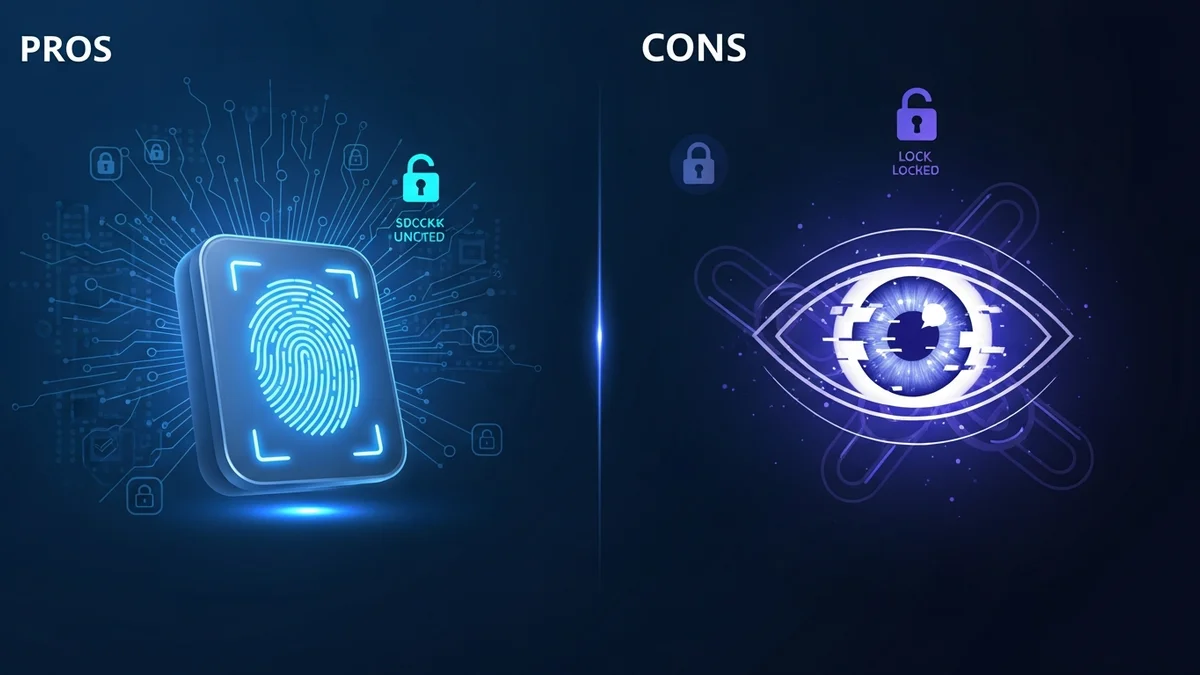
Biometric authentication has quickly moved from science fiction to everyday reality. Unlocking smartphones with a fingerprint, logging into banking apps with facial recognition, or accessing secure facilities via iris scans has become routine. Supporters claim biometrics are more secure and convenient than traditional passwords. Critics argue they introduce new privacy risks that are difficult—if not impossible—to reverse.
So, are biometrics truly the future of secure authentication? Or are they a double-edged sword? Let’s break down the real pros and cons of biometric authentication so you can decide whether it’s right for you.
What Is Biometric Authentication?
Biometric authentication verifies a person’s identity using unique biological traits. Common examples include:
- Fingerprint recognition
- Facial recognition
- Iris and retina scans
- Voice recognition
- Behavioral biometrics (typing patterns, gait, touchscreen pressure)
Unlike passwords or PINs, biometric identifiers are tied directly to your physical characteristics. According to a 2023 report by Goode Intelligence, more than 3.5 billion people worldwide use biometrics for identity verification. Apple’s Face ID and Touch ID alone are used by hundreds of millions of devices globally.
The rapid adoption is driven by two key promises: stronger security and greater convenience. But those promises deserve closer examination.
The Pros of Biometric Authentication
1. Convenience and Speed
Biometrics eliminate the need to remember complex passwords. A fingerprint scan takes less than a second. Face recognition works instantly. This speed improves user experience and reduces login friction, particularly for mobile banking and financial apps.
2. Reduced Password Fatigue
The average person manages dozens of online accounts. Weak, reused passwords remain a leading cause of data breaches. Verizon’s Data Breach Investigations Report consistently finds that stolen or compromised credentials are involved in a significant percentage of breaches.
Biometric login reduces reliance on passwords, helping mitigate credential stuffing attacks and password reuse problems.
3. Harder to Share or Steal Casually
Unlike passwords, biometric traits cannot be easily shared. You can give someone your PIN—but you cannot casually hand over your fingerprint. This makes insider misuse less likely in some scenarios.
4. Stronger Multi-Factor Authentication (MFA)
Biometrics work best when combined with other factors. Many security systems now use biometrics as one layer in multi-factor authentication, alongside something you know (a password) or something you have (a device).
When implemented correctly, this layered approach significantly reduces account takeover risks. Even if a password leaks in a breach, biometric verification adds another barrier.
The Cons of Biometric Authentication
1. Biometrics Cannot Be Changed
If your password is exposed, you can reset it. If your fingerprint template is stolen, you cannot change your fingerprint. This permanence is the biggest long-term risk of biometric systems.
In 2015, the U.S. Office of Personnel Management (OPM) breach exposed the fingerprints of approximately 5.6 million federal employees. Unlike passwords, those fingerprints are compromised for life.
2. False Positives and False Negatives
No biometric system is perfect. Facial recognition systems have been shown to produce higher error rates for certain demographic groups. A 2019 NIST study found that some facial recognition algorithms had significantly higher false positive rates for women and people of color.
False negatives can lock legitimate users out. False positives can grant access to the wrong person.
3. Privacy Concerns and Surveillance Risks
Biometric data can be collected without explicit user consent in some contexts, especially with facial recognition cameras. Once stored, biometric data becomes highly sensitive information.
If centralized databases are breached, attackers gain extremely valuable identifiers. Unlike leaked emails or passwords, biometric identifiers can potentially be misused in identity fraud for decades.
4. Spoofing and Bypass Techniques
Despite their sophistication, biometric systems can be fooled. Researchers have bypassed fingerprint sensors using high-resolution photos or 3D-printed molds. Early facial recognition systems were tricked with printed images or masks, though modern systems have improved liveness detection.
No authentication method is immune to attack. Biometrics simply shift the attack surface.
Biometrics vs. Passwords: Which Is Safer?
This isn’t an either-or debate. Password-only systems are clearly vulnerable. Massive breaches at companies like LinkedIn, Yahoo, and Adobe exposed billions of credentials over the past decade. Attackers frequently reuse these leaked credentials in automated attacks.
However, biometrics alone are not a silver bullet. The strongest approach combines:
- Biometrics (something you are)
- Strong, unique passwords (something you know)
- Device-based authentication (something you have)
Even with biometrics enabled, it’s critical to monitor whether your email addresses or credentials appear in data breaches. Tools like LeakDefend can monitor your email addresses for breaches and alert you if your credentials are exposed, helping you act before attackers do.
Where Biometrics Make the Most Sense
Biometric authentication is particularly effective when:
- Used locally on devices (e.g., unlocking a smartphone)
- Biometric data is stored securely in hardware (like Apple’s Secure Enclave)
- Combined with multi-factor authentication
- Backed by strong encryption and anti-spoofing protections
Problems typically arise when biometric data is stored in large centralized databases or when organizations fail to implement adequate safeguards.
For consumers, enabling fingerprint or facial recognition on personal devices is generally safer than relying on simple passwords alone. But that doesn’t eliminate the need for breach monitoring. If your email account is compromised, attackers may bypass biometric protections through password resets or phishing.
LeakDefend.com lets you check all your email addresses for free and receive alerts if they appear in new breaches—an essential layer of protection regardless of your authentication method.
The Bottom Line: Powerful, but Not Perfect
Biometric authentication offers clear advantages in convenience and can significantly strengthen security when used correctly. It reduces password fatigue, supports stronger multi-factor authentication, and limits casual credential sharing.
However, the risks are real. Biometric data is permanent, sensitive, and highly attractive to attackers. Breaches involving biometric identifiers carry long-term consequences that cannot simply be "reset."
The smartest approach is balanced security: use biometrics for convenience, pair them with strong passwords and MFA, and actively monitor your digital exposure.
🔒 Check If Your Email Was Breached — Monitor up to 3 email addresses for free with LeakDefend. Start Your Free Trial →
Biometrics are a powerful tool—but they’re not magic. Staying protected means combining smart authentication choices with proactive breach monitoring and identity awareness.
In a world where data breaches are inevitable, layered defense is the only strategy that truly works.