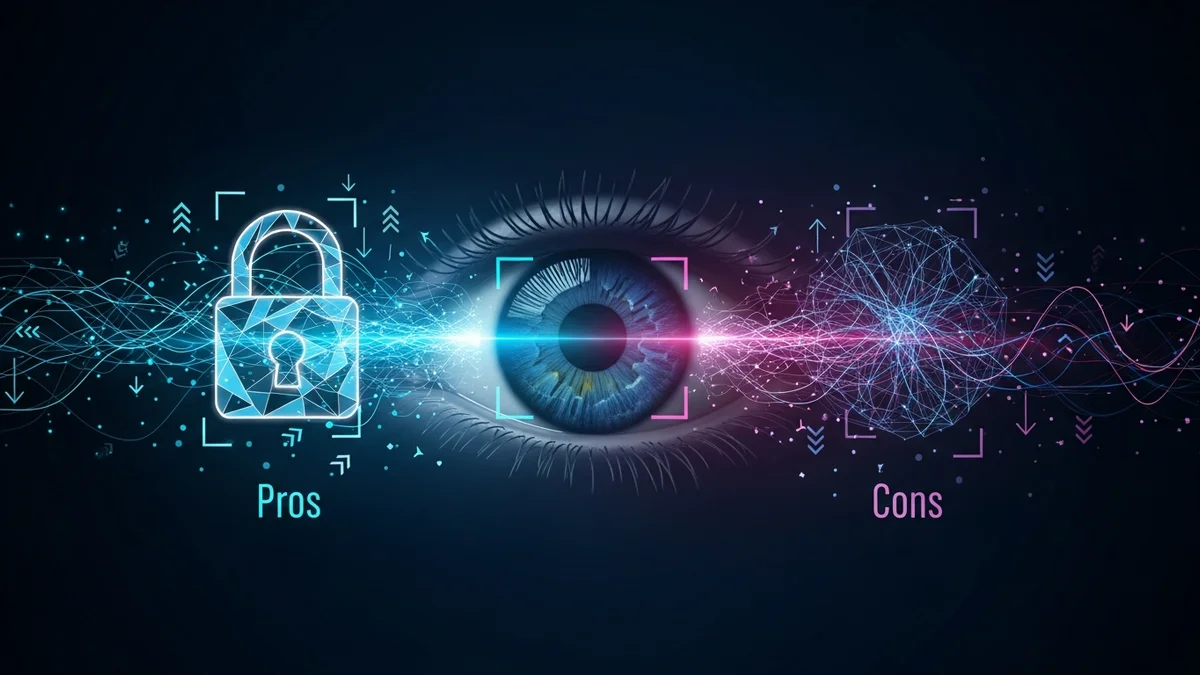
Biometric authentication has rapidly become a standard security feature. From unlocking smartphones with a fingerprint to passing through airport gates using facial recognition, biometrics promise a future without passwords. But while the technology feels seamless and futuristic, it also raises serious security and privacy questions.
Are biometrics truly safer than passwords? What happens if your fingerprint data is stolen? And can hackers spoof your face or voice? Understanding the pros and cons of biometric authentication is essential before trusting it with your most sensitive data.
What Is Biometric Authentication?
Biometric authentication verifies identity using unique physical or behavioral traits. Common examples include:
- Fingerprint recognition
- Facial recognition
- Iris or retina scans
- Voice recognition
- Behavioral biometrics (typing patterns, gait, mouse movements)
Unlike passwords or PINs, biometrics rely on characteristics that are inherently tied to you. According to Apple, the probability of a random person unlocking your iPhone with Face ID is approximately 1 in 1,000,000, compared to 1 in 50,000 for Touch ID fingerprint matching. These numbers highlight why biometrics are often viewed as highly secure.
However, no authentication method is perfect. To fully assess biometrics, we need to examine both sides.
The Pros of Biometric Authentication
1. Convenience and Speed
Biometrics eliminate the need to remember complex passwords. A quick glance or touch grants access in seconds. This reduces friction for users and lowers the risk of password fatigue, which often leads to weak or reused passwords.
2. Difficult to Guess or Brute-Force
Unlike passwords, biometric traits cannot be guessed or cracked through brute-force attacks. There’s no database of common fingerprints like there is for "123456" or "password."
3. Reduced Phishing Risk
Biometrics are resistant to traditional phishing attacks. A fake login page can trick you into typing your password, but it cannot directly capture your fingerprint from your device’s secure enclave.
4. Stronger Multi-Factor Authentication (MFA)
When combined with passwords or device-based authentication, biometrics significantly strengthen security. Many financial institutions now require fingerprint or facial recognition as part of two-factor authentication.
That said, biometrics are not immune to compromise.
The Cons of Biometric Authentication
1. You Can’t Change Your Biometrics
If your password leaks, you can reset it. If your fingerprint data is stolen, you cannot replace your fingers. This is a critical weakness.
In 2015, the U.S. Office of Personnel Management (OPM) breach exposed the fingerprint records of approximately 5.6 million federal employees. Those affected cannot simply "reset" their biometric identifiers.
2. Centralized Databases Are High-Value Targets
Large biometric databases attract attackers. Government identity systems, border control systems, and corporate access platforms store sensitive biometric templates. If compromised, the impact is long-term and irreversible.
3. False Positives and False Negatives
No system is 100% accurate. Environmental conditions, injuries, lighting, aging, or algorithm bias can affect accuracy. Studies have shown that some facial recognition systems have higher error rates for women and people of color, raising both security and ethical concerns.
4. Spoofing and Deepfake Threats
Biometric systems can be tricked. Researchers have bypassed fingerprint scanners using 3D-printed molds. In recent years, AI-generated deepfake voices have been used in financial fraud schemes, including a widely reported 2019 case where criminals used voice cloning to steal $243,000 from a UK energy firm.
Privacy and Ethical Concerns
Biometric data is deeply personal. Unlike passwords, it reveals physical characteristics that cannot be separated from your identity.
Mass facial recognition deployments have sparked debates worldwide. Some cities have banned government use of facial recognition technology due to concerns about surveillance and civil liberties.
Additionally, biometric data is often stored as mathematical templates, not raw images. While this reduces risk, breaches still expose sensitive identifiers that could potentially be reverse-engineered or misused.
Consumers must also consider how private companies store and share their biometric data. Transparency and strong encryption practices are essential.
Biometrics vs. Passwords: Which Is Safer?
The answer isn’t binary. Biometrics and passwords protect against different threats.
- Passwords are vulnerable to phishing, credential stuffing, and reuse across sites.
- Biometrics are vulnerable to database breaches and spoofing attempts.
Credential stuffing remains one of the most common attack methods today. Cybercriminals use breached username-password combinations to access other accounts. This is where biometrics offer an advantage, particularly when tied to a specific device.
However, many systems still rely on passwords in the background. If your email account is breached, attackers may bypass biometric protections through password resets.
That’s why monitoring your digital exposure remains critical. Tools like LeakDefend can monitor your email addresses for data breaches and alert you if your credentials appear in leaked databases. Even the strongest biometric system cannot protect an account if the underlying email and password are compromised.
Best Practices for Using Biometric Authentication Safely
If you choose to use biometrics, follow these guidelines:
- Enable multi-factor authentication whenever possible.
- Keep devices updated to patch security vulnerabilities.
- Avoid storing biometric data in untrusted apps.
- Use strong, unique passwords alongside biometrics.
- Monitor your email addresses for breaches.
Remember: biometrics protect access to your device, but they don’t stop data leaks happening elsewhere. If a company storing your information is breached, your data may still be exposed. LeakDefend.com lets you check all your email addresses for free and track potential exposures before they escalate into identity theft.
🔒 Check If Your Email Was Breached — Monitor up to 3 email addresses for free with LeakDefend. Start Your Free Trial →
Conclusion: Powerful but Not Perfect
Biometric authentication offers undeniable advantages: convenience, speed, and resistance to common password attacks. For everyday users, it often provides stronger protection than weak or reused passwords.
But biometrics are not a silver bullet. They introduce permanent risks if compromised, raise privacy concerns, and can still be bypassed under certain conditions. The smartest approach is layered security: combine biometrics with strong passwords, multi-factor authentication, and proactive breach monitoring.
In today’s threat landscape, security isn’t about choosing one method over another. It’s about building multiple defenses. Biometrics can be a powerful part of that strategy — as long as you understand both the pros and the cons.