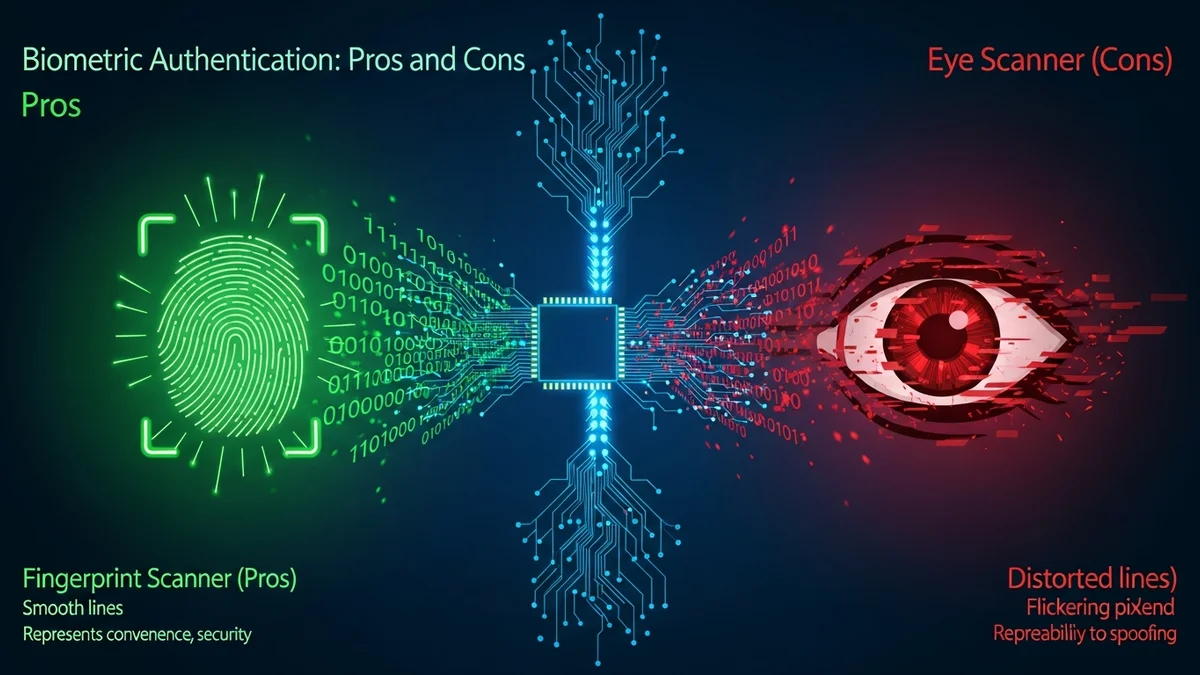
Biometric authentication is rapidly replacing passwords. From unlocking smartphones with a fingerprint to passing airport security with facial recognition, biometrics promise convenience and stronger protection. But are they really safer?
Understanding the pros and cons of biometric authentication is essential before relying on it to secure your devices, bank accounts, or workplace systems. While biometrics can reduce certain risks, they introduce new ones — especially around privacy, data breaches, and irreversibility.
Let’s take a balanced look at where biometrics shine — and where they fall short.
What Is Biometric Authentication?
Biometric authentication verifies identity using unique biological traits. Common types include:
- Fingerprint recognition
- Facial recognition
- Iris or retina scans
- Voice recognition
- Behavioral biometrics (typing patterns, gait analysis)
Unlike passwords or PINs, biometrics rely on something you are, not something you know. This makes them harder to guess or brute-force — but not impossible to exploit.
The Pros of Biometric Authentication
1. Convenience and Speed
One of the biggest advantages is ease of use. Unlocking your phone with a fingerprint or face scan takes seconds and eliminates the need to remember complex passwords.
According to a 2023 survey by Visa, over 70% of consumers consider biometrics easier than passwords. Faster authentication improves user experience and reduces friction in banking, e-commerce, and workplace logins.
2. Harder to Share or Guess
Passwords can be stolen, shared, reused, or phished. Biometrics are inherently personal. You can’t casually share your fingerprint the way you might share a Netflix password.
This reduces:
- Password reuse across multiple sites
- Credential stuffing attacks
- Phishing success rates
Given that Verizon’s Data Breach Investigations Report consistently finds that over 80% of breaches involve stolen or weak credentials, reducing password dependence is a major advantage.
3. Stronger Multi-Factor Authentication (MFA)
Biometrics work best when combined with other factors. Many modern systems use biometric authentication as part of multi-factor authentication (MFA), alongside a device or PIN.
This layered approach significantly improves security compared to passwords alone.
The Cons of Biometric Authentication
1. Biometrics Can Be Stolen — And You Can’t Change Them
This is the most serious downside.
If your password is compromised, you can change it. If your fingerprint data is stolen, you can’t change your fingerprint.
In 2015, the U.S. Office of Personnel Management (OPM) breach exposed the fingerprints of approximately 5.6 million federal employees. Unlike passwords, those biometric identifiers are permanently compromised.
More recently, biometric databases have been leaked due to misconfigured servers. In 2019, researchers discovered an unprotected database containing over 1 million fingerprint records and facial recognition data used by security firms.
Once exposed, biometric data becomes a long-term liability.
2. Privacy and Surveillance Concerns
Facial recognition technology has sparked global debate. Unlike passwords, biometrics can be collected without explicit consent — for example, via CCTV cameras.
Major cities have temporarily banned or restricted facial recognition use by law enforcement due to concerns about:
- Mass surveillance
- Misidentification
- Disproportionate impact on minority communities
In 2018, research from MIT found that commercial facial recognition systems had error rates of up to 34% for darker-skinned women, compared to less than 1% for lighter-skinned men. Although technology has improved, bias concerns remain.
3. False Positives and False Negatives
No biometric system is perfect.
- False positives: The system incorrectly grants access.
- False negatives: The system denies legitimate users.
Environmental factors like lighting, injuries to fingers, aging, or even identical twins (for facial recognition) can interfere with accuracy. In high-security environments, even a small false acceptance rate can pose serious risks.
4. Spoofing and Advanced Attacks
Despite their sophistication, biometric systems can be fooled.
- Researchers have bypassed fingerprint scanners using 3D-printed molds.
- High-resolution photos have tricked some facial recognition systems.
- AI-generated “deepfake” voices have been used to impersonate executives in fraud schemes.
As artificial intelligence advances, spoofing techniques are becoming more sophisticated. Biometric authentication is not immune to exploitation.
5. Centralized Storage Risks
When biometric data is stored centrally — especially by corporations or governments — it creates a high-value target for attackers.
If that database is breached, the consequences are severe and long-lasting. That’s why experts recommend on-device storage (such as Apple’s Secure Enclave) rather than cloud-based biometric repositories whenever possible.
Even if biometric data is stored securely, your other personal data may not be. Tools like LeakDefend can monitor your email addresses for breaches, helping you act quickly if associated accounts are exposed.
Are Biometrics Safer Than Passwords?
The answer isn’t simple.
Biometrics are generally safer than weak or reused passwords. But they are not safer than strong, unique passwords combined with multi-factor authentication.
The strongest security setups today combine:
- A strong, unique password
- Device-based authentication
- Biometric verification
- Breach monitoring
Even if biometric login protects your device, your credentials could still be leaked in a third-party breach. In 2024 alone, billions of credentials were exposed through compromised cloud services, SaaS platforms, and data brokers.
That’s why ongoing monitoring matters. LeakDefend.com lets you check all your email addresses for free and alerts you if they appear in known breaches — adding an essential layer beyond authentication alone.
Best Practices for Using Biometric Authentication Safely
- Use biometrics as part of multi-factor authentication, not as your only protection.
- Enable device encryption.
- Avoid systems that store biometric data in centralized, poorly documented databases.
- Keep software and firmware updated.
- Monitor your email addresses for breach exposure.
Security isn’t about choosing one method — it’s about layering defenses intelligently.
🔒 Check If Your Email Was Breached — Monitor up to 3 email addresses for free with LeakDefend. Start Your Free Trial →
Conclusion: A Powerful Tool — With Important Tradeoffs
The pros and cons of biometric authentication reveal a clear truth: biometrics are convenient and often more secure than passwords alone, but they are not invincible.
Their greatest strength — uniqueness — is also their greatest weakness. If compromised, biometric identifiers can’t be reset. Combined with privacy concerns and emerging spoofing threats, they require careful implementation.
Used wisely as part of a broader security strategy, biometrics can significantly enhance protection. But real security comes from layers: strong credentials, multi-factor authentication, secure storage practices, and continuous breach monitoring with services like LeakDefend.
In cybersecurity, convenience and caution must go hand in hand.