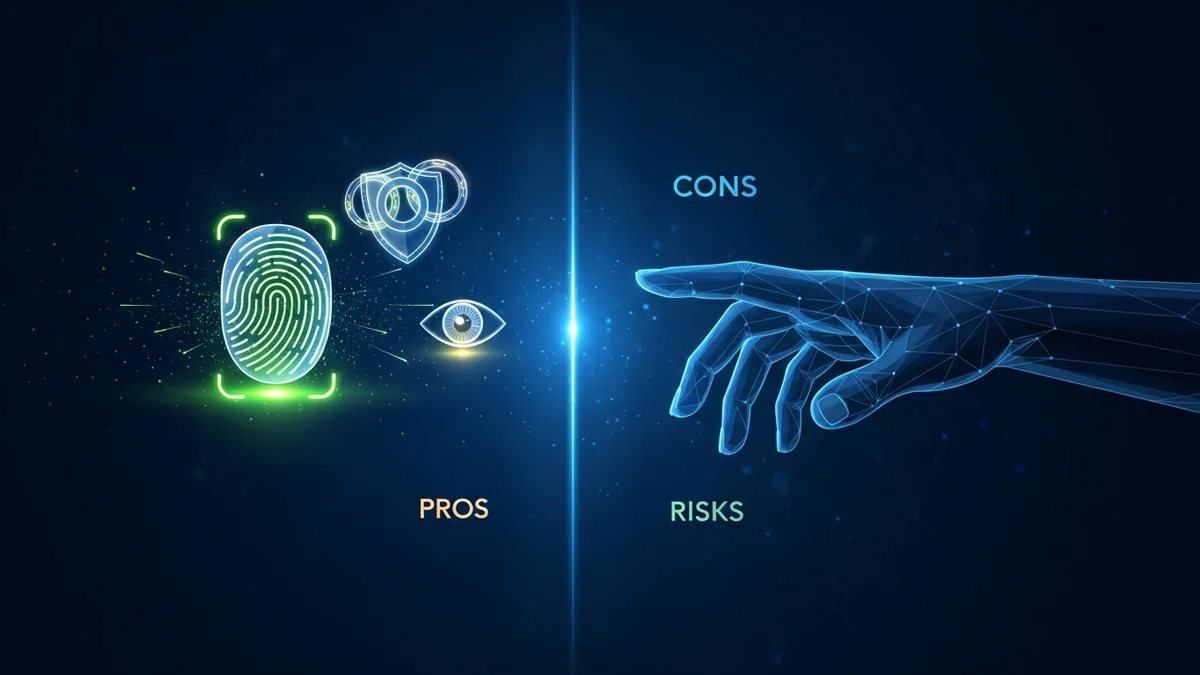
Biometric authentication has quickly moved from science fiction to everyday life. From unlocking smartphones with a fingerprint to passing airport checkpoints with facial recognition, biometrics promise stronger security and greater convenience than traditional passwords. But are they truly safer — and what risks come with replacing something you know (a password) with something you are?
In this article, we’ll explore the real pros and cons of biometric authentication, including practical security benefits, privacy implications, and what happens when biometric data is compromised.
What Is Biometric Authentication?
Biometric authentication verifies identity using unique physical or behavioral characteristics. Common examples include:
- Fingerprint recognition
- Facial recognition
- Iris or retina scans
- Voice recognition
- Behavioral biometrics (typing patterns, gait analysis)
Unlike passwords or PINs, biometric data is tied directly to your body. According to a 2023 survey by the FIDO Alliance, more than 58% of consumers prefer biometrics over passwords for account logins, citing convenience and perceived security.
However, convenience does not automatically equal safety.
The Pros of Biometric Authentication
1. Stronger Protection Against Password-Based Attacks
Traditional passwords are vulnerable to phishing, credential stuffing, brute force attacks, and data breaches. In contrast, biometric traits cannot be guessed or reused across accounts.
Verizon’s Data Breach Investigations Report consistently shows that stolen or weak credentials remain one of the top causes of breaches. By removing passwords from the equation, biometrics reduce exposure to:
- Phishing scams
- Password reuse attacks
- Dictionary and brute force attacks
When implemented correctly — especially as part of multi-factor authentication (MFA) — biometrics significantly strengthen login security.
2. Convenience and Speed
Typing complex passwords is frustrating. Resetting forgotten passwords is even worse. Biometric authentication simplifies this process. Unlocking a device with a fingerprint takes seconds and eliminates the need to memorize complex credentials.
This convenience increases user compliance with security policies. People are more likely to use strong security when it’s frictionless.
3. Reduced Credential Sharing
Passwords can be shared intentionally or unintentionally. Biometrics cannot be casually handed over. This limits insider threats and unauthorized access in workplace environments.
For businesses, biometric access control can reduce the risk of shared credentials or badge misuse.
The Cons of Biometric Authentication
1. Biometrics Can Be Stolen — And You Can’t Change Them
The biggest risk of biometric authentication is permanence. If your password leaks, you can change it. If your fingerprint data is stolen, you cannot change your fingerprint.
In 2019, the U.S. Customs and Border Protection agency confirmed a breach where facial recognition data was compromised. In another case, the Biostar 2 security platform exposed over 1 million fingerprints and facial recognition records in a misconfigured database.
Unlike passwords, biometric identifiers are lifelong. Once compromised, the damage may be irreversible.
This is why monitoring exposure across digital services is critical. Tools like LeakDefend can monitor your email addresses for breaches, alerting you if your credentials appear in leaked databases — helping you respond quickly before attackers pivot to other accounts.
2. Privacy Concerns and Mass Surveillance
Facial recognition has sparked widespread debate. Civil liberties groups warn about misuse by governments and corporations for surveillance.
In 2020, IBM, Amazon, and Microsoft paused or restricted facial recognition sales to law enforcement amid concerns about bias and misuse. Studies from MIT have shown that some facial recognition systems have higher error rates for women and people with darker skin tones.
Biometric data, if aggregated, can enable tracking far beyond authentication. Users often have limited visibility into how their data is stored, shared, or retained.
3. False Positives and False Negatives
No biometric system is perfect. Environmental conditions, injuries, aging, or technical limitations can lead to:
- False positives: Unauthorized users are granted access.
- False negatives: Legitimate users are denied access.
Even advanced systems have measurable error rates. While these rates are often low, at scale they can affect millions of users. High-security environments must balance convenience with acceptable risk thresholds.
4. Spoofing and Biometric Bypass Techniques
Contrary to popular belief, biometrics are not impossible to fake. Researchers have demonstrated:
- 3D-printed fingerprints that unlock sensors
- High-resolution photos tricking facial recognition
- Recorded voices bypassing voice authentication
While modern systems incorporate liveness detection and anti-spoofing measures, attackers continually evolve. Security is never absolute.
Biometrics vs. Passwords: What’s the Right Approach?
The debate isn’t biometrics or passwords — it’s about layered security.
Security experts recommend combining biometrics with:
- Multi-factor authentication (MFA)
- Device-based cryptographic keys (such as passkeys)
- Continuous breach monitoring
Even if biometrics protect device access, your email and online accounts can still be compromised through data breaches. In 2024 alone, billions of records were exposed globally through misconfigured databases and ransomware leaks.
That’s why proactive monitoring matters. LeakDefend.com lets you check all your email addresses for free and receive alerts if they appear in known breach datasets. Biometric security on your device won’t help if attackers already have your leaked credentials elsewhere.
🔒 Check If Your Email Was Breached — Monitor up to 3 email addresses for free with LeakDefend. Start Your Free Trial →
Are Biometrics the Future of Authentication?
Biometric authentication is undeniably growing. Apple’s Face ID, Android fingerprint sensors, airport e-gates, and banking apps all demonstrate widespread adoption. Passkeys — backed by Apple, Google, and Microsoft — increasingly rely on biometric confirmation combined with device-bound cryptographic keys.
This hybrid approach may represent the most secure future: biometrics for convenience, cryptography for security, and ongoing monitoring for breach detection.
But biometrics are not a silver bullet. They reduce certain risks while introducing new ones — particularly around privacy and irreversibility.
Conclusion: Weighing the Pros and Cons of Biometric Authentication
The pros and cons of biometric authentication reveal a clear truth: biometrics improve usability and reduce password-based attacks, but they are not invulnerable. They can be spoofed, stolen, or misused — and unlike passwords, they cannot be reset.
The smartest strategy is layered defense. Use biometric authentication where available, enable multi-factor authentication, avoid password reuse, and actively monitor your digital footprint for exposure.
Security today isn’t about choosing one method — it’s about building multiple lines of defense. When convenience meets vigilance, you get protection that actually works.