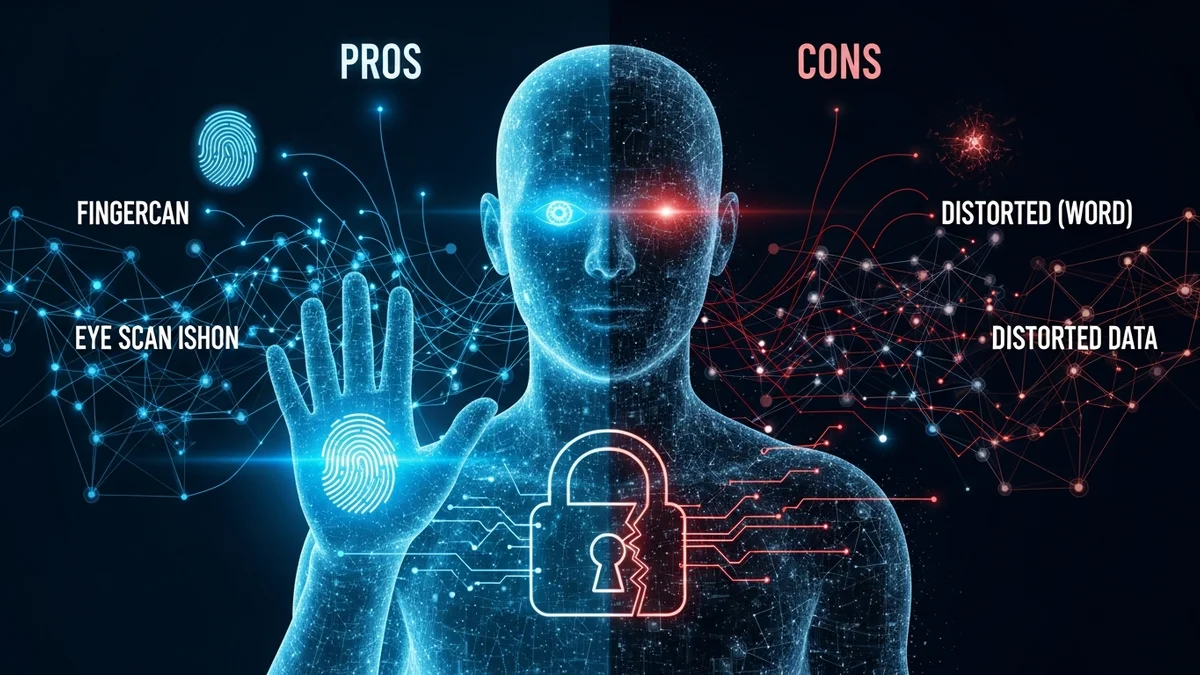
Biometric authentication has quickly moved from science fiction to everyday reality. From unlocking smartphones with a fingerprint to passing through airport security with facial recognition, biometrics are now a mainstream security tool. The appeal is obvious: you are the password.
But while biometric authentication offers convenience and stronger identity verification in many cases, it also introduces serious privacy and security risks. Unlike passwords, you can’t reset your fingerprint or change your face if something goes wrong.
In this article, we’ll explore the real pros and cons of biometric authentication, backed by facts and real-world examples, so you can decide when it strengthens security—and when it may create new vulnerabilities.
What Is Biometric Authentication?
Biometric authentication uses unique physical or behavioral characteristics to verify identity. Common forms include:
- Fingerprint recognition
- Facial recognition
- Iris or retina scans
- Voice recognition
- Behavioral biometrics (typing patterns, mouse movements)
Instead of something you know (a password) or something you have (a security key), biometrics rely on something you are. This shifts authentication away from memorization and toward inherent identity traits.
Major tech companies including Apple, Google, and Microsoft now integrate biometrics into default authentication flows. According to industry reports, over 80% of smartphones globally support some form of biometric unlock.
The Pros of Biometric Authentication
Biometric authentication has clear advantages that explain its rapid adoption.
1. Convenience and Speed
Biometrics eliminate the need to remember complex passwords. A fingerprint scan or quick facial recognition check takes seconds. This reduces friction, especially for mobile banking, password managers, and secure apps.
2. Reduced Password Fatigue
The average person manages dozens—if not hundreds—of online accounts. Password reuse remains a major security problem. By replacing or supplementing passwords, biometrics can reduce risky behaviors like reusing weak credentials across multiple sites.
3. Stronger Identity Verification
When implemented correctly, biometric systems can significantly reduce unauthorized access. For example, modern fingerprint sensors and Apple’s Face ID use advanced liveness detection to prevent simple spoofing with photos or molds.
4. Useful in Multi-Factor Authentication (MFA)
Biometrics are especially powerful when combined with other factors. A fingerprint plus a device token or passcode creates layered security that is far harder to bypass than passwords alone.
In enterprise environments, biometrics have reduced certain forms of internal fraud and badge-sharing. In healthcare and financial services, biometric logins can help ensure that only authorized personnel access sensitive systems.
The Cons of Biometric Authentication
Despite its advantages, biometric authentication is far from perfect—and in some cases, it introduces permanent risks.
1. You Can’t Change Your Biometrics
If a password is leaked in a data breach, you can reset it instantly. If your fingerprint template is compromised, you can’t replace your fingerprint. That makes biometric breaches particularly serious.
In 2019, researchers revealed that over 1 million fingerprints and facial recognition records were exposed due to a misconfigured biometric database used by security systems worldwide. Unlike passwords, this data could not simply be “reset.”
2. False Positives and False Negatives
No biometric system is 100% accurate. False positives (granting access to the wrong person) and false negatives (blocking legitimate users) both occur. Facial recognition systems, in particular, have faced criticism for demographic bias and higher error rates among certain populations.
3. Privacy Concerns
Biometric data is deeply personal. When collected at scale—by governments, corporations, or advertisers—it raises surveillance concerns. Once your facial data is stored in a central database, it could theoretically be used for tracking without your knowledge.
High-profile controversies involving companies like Clearview AI have shown how facial recognition databases can be built using scraped public images, often without consent.
4. Spoofing and Advanced Attacks
While biometric systems have improved, they are not immune to attack. Researchers have demonstrated ways to bypass fingerprint readers with lifted prints and to fool facial systems with 3D masks or high-resolution images in poorly designed systems.
Biometrics and Data Breaches: What’s the Real Risk?
One common misconception is that biometrics eliminate breach risk. They don’t.
Most modern systems do not store raw fingerprint images. Instead, they store encrypted biometric templates. However, if attackers access poorly secured databases or exploit weak encryption, those templates can still be exposed.
Additionally, biometrics often protect accounts that still rely on traditional backend credentials. If your email address and password are compromised in a breach, attackers may bypass biometric protections by logging in on a different device.
This is why monitoring for data exposure remains critical. Tools like LeakDefend can monitor your email addresses for breaches and alert you if your credentials appear in leaked databases. Even if you use biometric login on your phone, your underlying account security still depends on strong password hygiene and breach detection.
When Is Biometric Authentication a Good Idea?
Biometric authentication works best when:
- It’s combined with multi-factor authentication.
- Biometric data is stored locally on secure hardware (like a device’s secure enclave).
- It protects high-value accounts such as banking or password managers.
- Users maintain strong, unique passwords as a backup.
It’s less ideal when biometric data is stored in large centralized databases with unclear security practices.
Remember: biometrics are a convenience layer—not a silver bullet. If your email account is breached, attackers can still reset passwords for dozens of other services. That’s why proactive monitoring matters. LeakDefend.com lets you check all your email addresses for free and see whether your information has already been exposed in known data breaches.
The Bottom Line: Security vs. Permanence
The pros and cons of biometric authentication come down to a simple tradeoff: convenience and strong identity verification versus permanence and privacy risk.
Used correctly—especially as part of multi-factor authentication—biometrics can significantly improve security and reduce password fatigue. Used carelessly, or stored insecurely, they can create long-term exposure that cannot be undone.
The smartest approach is layered protection:
- Use biometrics for convenience.
- Maintain strong, unique passwords.
- Enable multi-factor authentication wherever possible.
- Monitor your accounts for breaches.
Security is never about a single tool. It’s about combining defenses so that if one fails, others still protect you.
🔒 Check If Your Email Was Breached — Monitor up to 3 email addresses for free with LeakDefend. Start Your Free Trial →
Biometric authentication is powerful—but it doesn’t replace vigilance. Stay informed, layer your defenses, and use monitoring tools like LeakDefend to ensure that your digital identity stays protected, even when breaches happen.